For Makati residents and businesses, the national government’s woefully inadequate pandemic response was in sharp contrast to the innovative schemes that the city government came up with to cope with the challenges that emerged from the imposed lockdowns and restrictions.
With limited public transportation in March 2020, Makati Mayor Abby Binay provided shuttle buses to bring front-liners to their workplaces, while directing barangay officials to lend their vehicles to residents for nonemergency medical cases. Jeepney and pedicab drivers were similarly deployed to ferry patients and workers during the lockdown.
The city was also among those that pushed for mass testing, with persons under investigation and under monitoring undergoing RT-PCR tests in April 2020, to “ensure that the already thinning number of medical front-liners do not get sick or spread the virus to their patients and workmates,” Binay said.
Reduced cost of testing
The city government also partnered with private laboratories to cut the cost of RT-PCR testing from P4,500 to P8,500, to a more reasonable P1,000 through pool testing.
With businesses closing because of the lockdown, Makati allotted P2.7 billion in financial aid for its residents, on top of the “ayuda” given by the national government. Almost 115,000 of the city’s beneficiaries received the P5,000 aid within six days after the payout started—thanks to the city’s existing Makatizen card system that allowed it to download the money directly to electronic wallets via GCash. This made Makati the first local government in the country to use contactless cash distribution during the COVID-19 crisis. Even better, instead of providing the cash assistance per household, it was given to individual residents, enabling those who had lost their jobs to pool the cash aid for several household members and start small businesses.
The city’s at least 78,000 businesses also found relief in grants of P10,000 to P100,000 under the P2.5-billion Makati Assistance and Support to Businesses program, that they could use for supplies and the salaries of their workers, whether they are Makati residents or not.
P1B for vaccines
Health concerns were considered as well, with the city rolling out free flu and pneumonia shots for medical front-liners, essential workers and residents in July 2020, a year before the national government started its vaccination program. When local governments were allowed to procure their own COVID-19 vaccines through the national government, Makati allotted P1 billion for it.
In May 2021, the city became the first local government in the Metro to open its drive-thru vaccination site to accommodate bedridden residents and persons with disability. Tricycles and barangay ambulances were also deployed to bring these individuals to the sites and back home again.
‘Dyipni Maki’
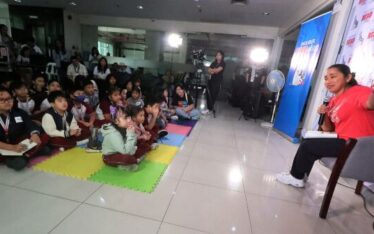
With schools closed and students finding it difficult to access online classes for lack of laptops and internet connection, the Makati government repurposed 29 jeepneys as mobile learning hubs under its “Dyipni Maki” project. Equipped with computers, Wi-Fi, books and supplementary materials that parents could borrow, the jeepneys served as venues for learning and reading activities, book donation drives and other activities promoting reading in communities. Staffing the hubs were 58 private school teachers who had lost their jobs due to the pandemic. Displaced jeepney drivers also found employment in Dyipni Maki.
“We’re glad that we have come up with a project that addresses multiple issues simultaneously,” Binay said. “Not only will it help students and their parents cope with the new ‘blended learning’ approach in education, it will also provide much-needed employment to Makatizens,” she added. INQ