As the Inquirer stays true to its mission of telling the story of the Filipino, the company behind the country’s most trusted newspaper has no dearth of stories of its own when it comes to making a difference in communities or individual lives.
The organization’s corporate arm, mostly through the Inquirer Foundation, continued to find its own heroes and champions through its partners, readers and volunteers.
For more than two years now amid the still-lingering concerns over the pandemic, and especially in 2022, the foundation has never ceased to deliver on its commitment to support youth advocacies and outreach programs for victims of calamities. It also introduced ways to cope with and recover from the pandemic through various programs that inspire different stakeholders and readers in general. The success of each project wouldn’t have been possible without the Inquirer’s internal support system, which has grown through the years.
INQskwela with Valenzuela
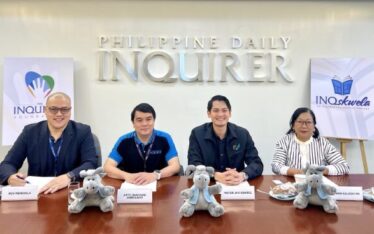
In May this year, the Valenzuela City government and the newspaper, through the Inquirer Foundation, entered into a partnership to promote reading and media literacy among students and teachers.
“When I was a kid, I remember clipping articles from newspapers and pasting them on bond paper as homework. I want this project to bring back the joy in reading newspapers,” then Valenzuela City Mayor Rex Gatchalian said at the launch of the INQskwela project.
Under INQskwela, partner schools will incorporate news reports and other information published in the paper into the students’ lessons, particularly in their social studies, English and journalism subjects.
One of goals is for the youth to be mindful of fake news and, in their own way, help fight disinformation by choosing only credible sources and becoming aware of the dubious ones.
The partnership is proof that the Department of Education, the City of Valenzuela and the Inquirer have a common understanding of what public service really means, according to Inquirer president and CEO Rudyard Arbolado.
With Valenzuela taking the lead, there is hope for this kind of partnership to flourish among local governments in Metro Manila and later across the country. This network of partnerships, he said, will be an ideal forum for exchanging ideas, techniques and best practices for the advancement of the country’s educational system. “The true winners here are our youth and the country,” Arbolado added.
Culminating INQskwela activities, such as a quiz bee and a debate, were held in May and June.
Inquirer scholars
The company also welcomed a new batch of scholars who qualified for the Inquirer Journalism Scholarship Grant for school year 2022-2023, namely Gabryelle Dumalag, Renz Joshua Palalimpa and Luisa Angela Sandoval.
The Inquirer partnered with the University of the Philippines College of Mass Communication in the search for the most qualified applicants, mainly students who had a grade not lower than 1.75, were in need of financial assistance, and who had shown a drive to pursue a career in journalism. The scholarship grant provides them with a monthly stipend, on top of allowances for books, school supplies, telco and internet services, and board and lodging, plus a graduation gift.
Within six months after graduation, the scholars will be offered employment in the company for at least one year, after which they may decide to stay or explore other opportunities.For this particular program and other activities, the Inquirer Foundation is gratefully supported by SM Prime’s 100 Days of Caring initiative.
Artkipelago
Through the online learning platform Artkipelago, the Inquirer offered another set of scholarship grants to high school, college students, fresh graduates and young professionals.Artkipelago is a virtual school for the arts that is designed for both beginners and professionals who wish to develop their potential or fine-tune their craft. It offers courses in major creative fields like music, film and the performing arts, with more programs added almost every month.
The study period for the scholarship program is from April to December. To date, more than 150 scholars have enlisted and eventually finished their chosen courses in 30 days. “The Inquirer Foundation is grateful to Artkipelago for helping us extend opportunities and knowledge to aspiring individuals with creative inclinations,” said Connie Kalagayan, the foundation’s executive director. “We hope that we can further our mission to empower the youth through these scholarship grants. May this learning opportunity inspire and ignite passion to propel our youth further to better themselves and achieve their dreams.”
Virtual Read-Along
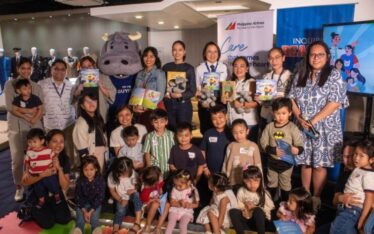
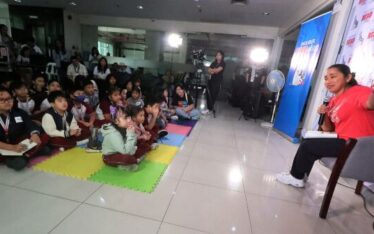
In its third year of holding virtual reading sessions, the Inquirer Read-Along program would like to honor its partners, friends, ambassadors and volunteers for their tireless support to one of the paper longest-running advocacies.
In February, Inquirer Read-Along shared stories of the power of courage in the face adversity, in a session with children held in partnership with Smart Communications. It featured TV host and model Andi Manzano Reyes as the guest celebrity storyteller.
The second virtual Read-Along for the year was held in June, this time in partnership with Globe. It featured celebrity reader Arlene Muhlach and tackled stories about sustainability in line with the observance of Philippine Environment Month.
In October, kids learned about different kinds of heroism in another virtual session made possible with the help of Metrobank Foundation.
Celebrity Nikki Valdez and two Metrobank Foundation Outstanding Filipino awardees—Col. Stephen L. Cabanlet and teacher Christine Joy Dr. Aguila—served as storytellers.To wind up the year, Inquirer Read-Along held its 12th festival in November, with stories focusing on responsible money habits. The program was conducted with the help of partners from Insular Life. The festival featured longtime Read-Along ambassadors and friends, namely Patricia Tumulak and Kim Atienza, as guest storytellers.
The program is also thankful to storytellers Ann Abacan, Rich Rodriguez and Dyali Justo; Inquirer.net and the core members of the Read-Along team.
Internships, immersion
The Inquirer also welcomed a number of senior high school and college students from various schools for the company’s internship and immersion programs, which were conducted online due to prevailing pandemic conditions.
These include the National University, UP Baguio, Lyceum of the Philippines Manila, Saint Pedro Poveda College, Cavite State University Indang, University of Santo Tomas, University of the Philippines (UP) Diliman, UP Los Baños, Ateneo de Manila University, Polytechnic University of the Philippines, Everest Academy Manila, International School Manila, De La Salle College of St. Benilde, De La Salle University and Deerfield Academy. The students were assigned to the different sections of the paper (Research, Sports and Lifestyle) as well to the company’s marketing and special projects units.
Year 2 of Project Rebound
The paper’s unique, award-winning webinar series born out of the pandemic was able to sustain its momentum on its second year.
Launched in May 2021, Project Rebound seeks to serve as a forum for sharing best practices and insights on how industries, sectors, communities, families or individuals can adjust and best recover from the slump brought about by the health crisis.For 2022, among the topics covered by the webinars were cybersecurity, food security, logistics, health care, tourism, e-commerce, zero waste, entrepreneurship and inclusive education. A total of 13 organizations partnered with the paper for the 2022 webinars. (There were 11 webinars and 14 partner organizations during the first year.)
Intensive Care Corner
Consistency has been the hallmark of the newspaper’s medical assistance program—Intensive Care Corner (ICC).
Published weekly in the Inquirer and also on Inquirer.net, the stories of indigent patients appealing to readers and potential donors for financial support for their urgent medical needs are now also shared through the Inquirer Foundation’s Facebook account, the Inquirer Mobile app and the Inquirer email newsletters for a wider reach. Medical cases sent to the newspaper for publication are duly vetted and written by the staff. Follow-up reports are made if necessary to give updates on the patient’s recovery or continuing needs.
Launched in the early 2000s, ICC is now considered one of the most enduring and helpful public service initiatives of the company.
A total of 20 patients have been featured so far this year, the patients age between 6 and 60 years old. They were suffering from leukemia (11 cases), other types of cancer (4), kidney disease (3), gastrointestinal bleeding and liver disease (1 case each).
‘Karding,’ ‘Paeng’ aid
Again with the help of readers, the Inquirer Foundation was able to raise funds and contribute to postcalamity relief efforts.
In the aftermath of Supertyphoon “Karding” (international name: Noru) which hit in September, the paper was able to help in the renovation of the Sacred Heart Parish church in Bulacan province, one of the structures damaged by the storm.
As of this writing, the foundation is coordinating with the Local Youth Development Council of Biñan City in Laguna province for donations received by the company on behalf of the victims of Typhoon “Paeng,” (Nalgae) which struck in late October. INQ