Imagine the Philippines’ education system as a leaky faucet. A sturdy bucket could help stop the wastage, but it won’t be enough; the problem needs fixing.
That’s exactly the reason for being of Teach for the Philippines (TFP), a nonstock and nonprofit organization, that sees itself not as a handy bucket, “but [the means] that turns off that leaky faucet.”
Established in 2012, TFP was formerly known as “Sa Aklat Sisikat Foundation,” whose 30-day reading program was found to have a “significant positive impact” on the reading skills of students, according to the Massachusetts Institute of Technology-based Poverty Action Lab.
“The cofounders had a lot of talk with the researchers, and realized that it wasn’t enough to just roll out literacy programs,” noted TFP chief operations officer Mavie Ungco. “If you are going to try to change and transform the education system for the better, [what was] needed was a more complex, systemic response,” she added.
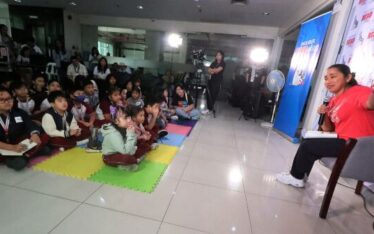
The organization, which celebrates its 10th anniversary this year, has reached an estimated 80,000 students nationwide and trained more than 300 teacher fellows under its flagship “Fellowship Program” since it was founded. The program recruits, trains and deploys promising young Filipinos to TFP’s partner public schools nationwide.
Czarina Nacionales, a fellow who was assigned to Negros Occidental in 2020, said the main challenge amid the pandemic was the online mode of learning since not everyone in the community had internet access.
“I was quite sad because Victorias Elementary School is big and is a central school, but I only had about 30 students who had the opportunity to go online,” she said.
The pandemic contributed to making 2020 to 2021 a “crazy” period, Ungco said, citing the unavailability of the COVID-19 vaccine at the time. The organization’s biggest hurdle then was the physical deployment of teachers “despite the risks since there was just no way that we could reach students and communities remotely.”
To cope with the problem, TFP’s literacy program pivoted to capacitate and support parents in teaching their kids at home.
“We also tapped our donors for auxiliary assistance–not directly about education intervention but more on access for (needed supplies for online learning) like printers for (TFP partner-) public schools, ink, paper, even PPE (personal protective equipment), masks and alcohol,” Ungco said.
The two other TFP initiatives are the “Ambassadors Program,” which provides technical support to government agencies working on education, and the “Public School Teacher Pathways Program,” which supplements the Department of Education’s push for more opportunities for the teachers’ professional development.
“There is no deeper motivation other than (helping) the kids. Our kids need us. Education is important because it is the future of our country,” Ungco said.
She added: “If you can’t read, write, or count, you’d have a hard time living with dignity. (Education gives you the) choice and capability to change your life for the better, and to help yourself and your family.” INQ